
Chesterfield County Deed Records and Instruments
Chesterfield County deed records live with the Circuit Court Clerk. The online index works by name rather than by street address. That shapes how any search has to go. Find the owner of record first. Then search Chesterfield County deeds by grantor or grantee to trace each transfer. Maps and plat records help pin down the parcel number tied to a deed. Assessment data helps with that too. A recorded deed proves one thing clearly: the instrument was filed. It cannot settle every title question or reveal an unrecorded claim, so deeper questions may need a title professional. Start with the names, and the chain of deeds follows.
| Deed Type | What It Does | Common Use |
|---|---|---|
| Deed of conveyance | Records a transfer of an interest in real property. | Reviewing the named grantor, grantee and land description. |
| Executor or administrator deed | Can document a transfer signed for an estate. | Following a death-related property transfer. |
| Special-warranty deed | The county says a judicial-sale buyer receives one without title-insurability warranty. | Reviewing a court-approved tax sale. |
| Deed of trust or mortgage | Records a secured loan interest, not a change in owner by itself. | Checking a lien or later release. |
| Recorded plat | Shows a recorded subdivision layout, lot and block context. | Matching a deed description to an official map. |
Not every recorded document does the same job. A deed asserts that ownership moved, while a deed of trust, mortgage, or judgment lien records a claim against the land. The Clerk records these instruments without interpreting which lien ranks first. So a list of recorded documents is raw material, not a legal conclusion about what remains enforceable against the property.
Chesterfield County's 1749 Record Books
Chesterfield County's permanent land and court records reach back to the county's founding in 1749, according to the Clerk. The online deed index starts much later, in 1967. That gap is wide. For older transfers, an owner history may call for the Record Room, the historic deed books, the Library of Virginia, FamilySearch, or the Chesterfield Historical Society. The county confirms when its records begin. But it publishes no book-by-book catalog, and no loss event is recorded that would explain missing volumes. The county's own history fills in some color. It places the first court session in 1749. It also notes that a courthouse was authorized soon after. A replica of the original 1750 courthouse opened as a museum in 1980. The 1917 courthouse still stands as a landmark. Those dates frame the deed books nicely. The recorded instruments themselves remain the evidence of any transfer. The Clerk's Land Records information spells out the coverage distinction. Before diving into older indexes, pull the owner names and the full legal description from the current deed for the parcel.
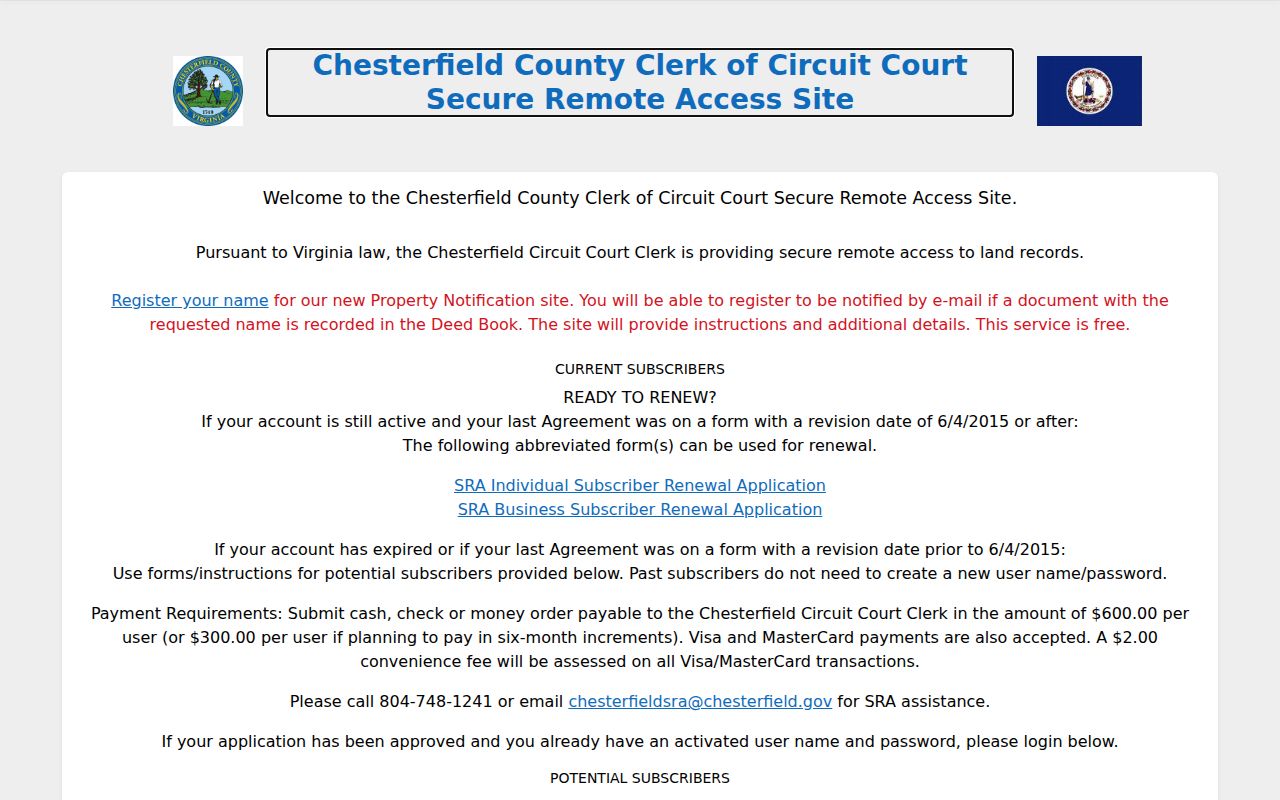
The county's public land-records page is the entry point for the online index. Its live search controls are best confirmed directly in a browser when you sit down to run a name search.
Chesterfield County Grantor and Grantee Search
Names drive this index. Begin with a known grantor or grantee. Then search both roles as you walk the chain through earlier transfers. An address alone will not pull the full chain. The Clerk's index is not built around street addresses or legal descriptions. Guard against false matches. The 15-digit tax ID and the written land description confirm that a party-name result really concerns the parcel you are chasing.
| Search detail | What research confirms | How to use it |
|---|---|---|
| Party name and role | Index is organized by name, not address. | Search as grantor and grantee. |
| Document type | Deeds, deeds of trust, liens, plats, judgments and wills are identified. | Exact dropdown choices are unverified. |
| Coverage | Online deeds are listed from 1967 to current. | Older entries require an archive path. |
| Record reference | Expected book/page or document number was not visible. | Confirm the live portal or Record Room copy. |
The county publishes no sample result row from its portal. Treat any field beyond the county's own published facts as unconfirmed until the live index displays it.
The Chesterfield Grantor-Grantee Index
A grantor gives up an interest in land; a grantee receives it. That pairing is the spine of a Chesterfield County deed search. Work backward from the deed naming the current grantee. The grantor on that instrument points to the prior transfer. At every step, match the legal description and tax ID, because one person can hold several parcels and a single parcel may have carried different descriptions over the years. Careful matching keeps the chain honest.
- Find the deed naming the current owner as grantee.
- Copy the grantor name and the full land description from that instrument.
- Search the same party as a grantee to locate the prior acquisition.
- Repeat until the online 1967 cutoff, then ask for the older deed-book route.
- Grantor
- The named party conveying an interest in the instrument.
- Grantee
- The named party receiving an interest in the instrument.
- Chain of title
- The sequence of recorded transfers used to trace ownership claims over time.
- Book and page or document number
- A filing reference, if displayed; the CCC portal's exact result format was not verified.
Chesterfield County Deed Filing Rules
A paper deed filing in Chesterfield County calls for the original instrument with signatures and notarization. You also need a Land Records Cover Sheet and a self-addressed stamped envelope. The first page must state the consideration. It must also carry the affected 15-digit tax ID under Va. Code §17.1-252. The Clerk will not knowingly record an instrument bearing a Social Security number, per §17.1-227. These rules govern new filings only. They do not change how older deeds were indexed. Electronic recording covers most Deed Book documents. Plats are excluded. The county lists certain assumption, exchange, contract, and manual-calculation documents as off limits without approval. Check the Clerk's current instructions before submitting anything. A rejected filing can delay the public record.
Official Chesterfield County Plats
Recorded subdivision plats are the business of the Circuit Court Clerk. The Clerk is the official repository for those maps. An assessor's subdivision copy is informational only. The Clerk's recorded plat is the map of record. Plats can show lot and block, roads, easements, and dedications. That makes them useful alongside a deed. Still, a plat never replaces the deed or a current survey. The Clerk's plat instructions explain how recordation works. The Real Property Office handles easement plats and county real-property matters. It offers no boundary services. For a boundary question, a licensed land surveyor is the route.
The plat instructions draw a clear line between the official record and an informational copy. Compare the recorded plat against the legal description in the deed before relying on either one.
Chesterfield County Index and Remote Access
Chesterfield County offers a free public deed index through its CCC Land Records site. Virginia adds a second route. Its statewide Secure Remote Access system serves participating clerks. The Judiciary permits free index-only viewing where a locality enables it, while secured remote images of land records generally require a subscription. The Virginia SRA page explains that split. Access terms still vary by locality. Free index hits and image subscriptions are separate steps. The Record Room remains the in-person fallback for Chesterfield County deed records. Staff help patrons use the resources but will not perform a title search.
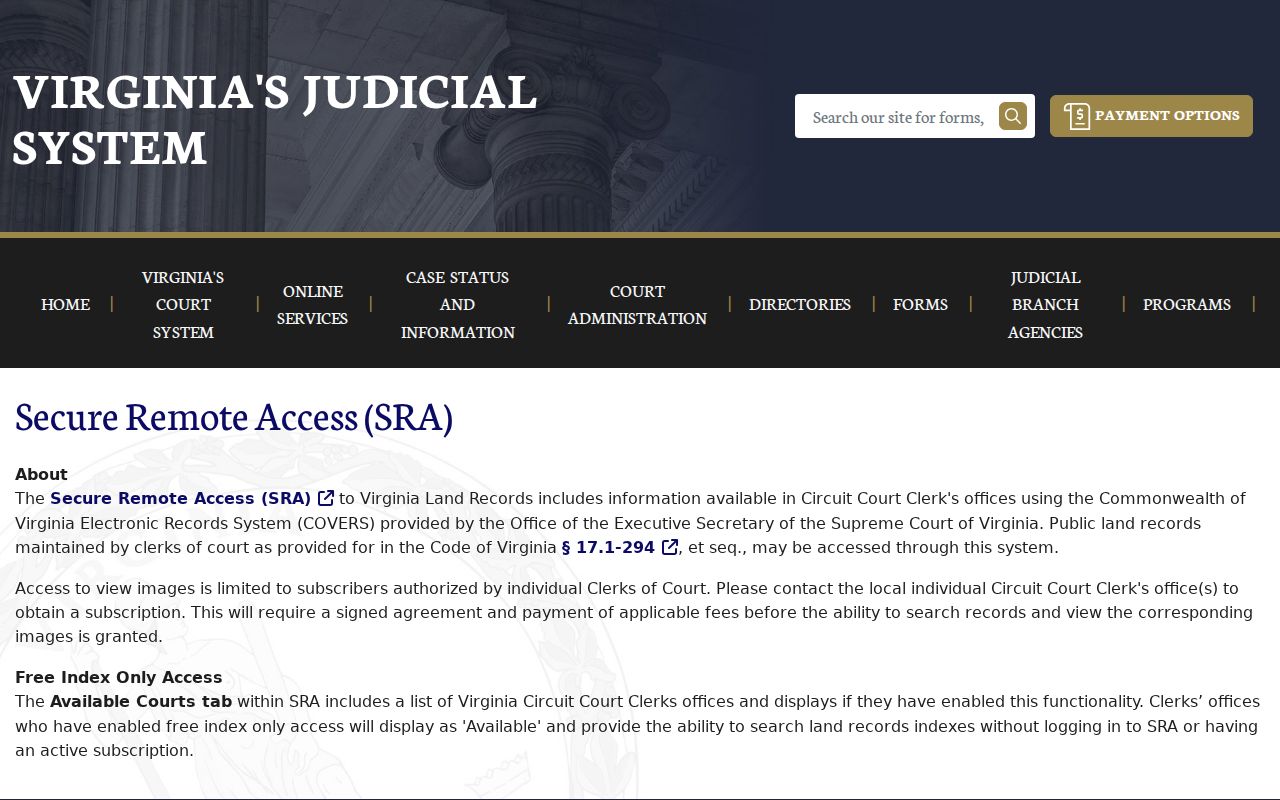
The state portal separates index-only access from subscriber access. That distinction is not a promise that every Chesterfield County deed image is free online.
Chesterfield County Deed Alerts
Property Notification sends free email alerts whenever a registered name or parcel number appears in covered filings. It can flag a deed or deed of trust. It is not a signature test. The Clerk records instruments that meet legal standards. The office cannot verify whether the true owner actually signed them. Enroll through the Property Notification service. If an alert flags a filing you did not expect, inspect the instrument and call the Record Room at 804-717-6517. The alert helps a Chesterfield County property owner notice activity; it does not decide whether the document is valid.
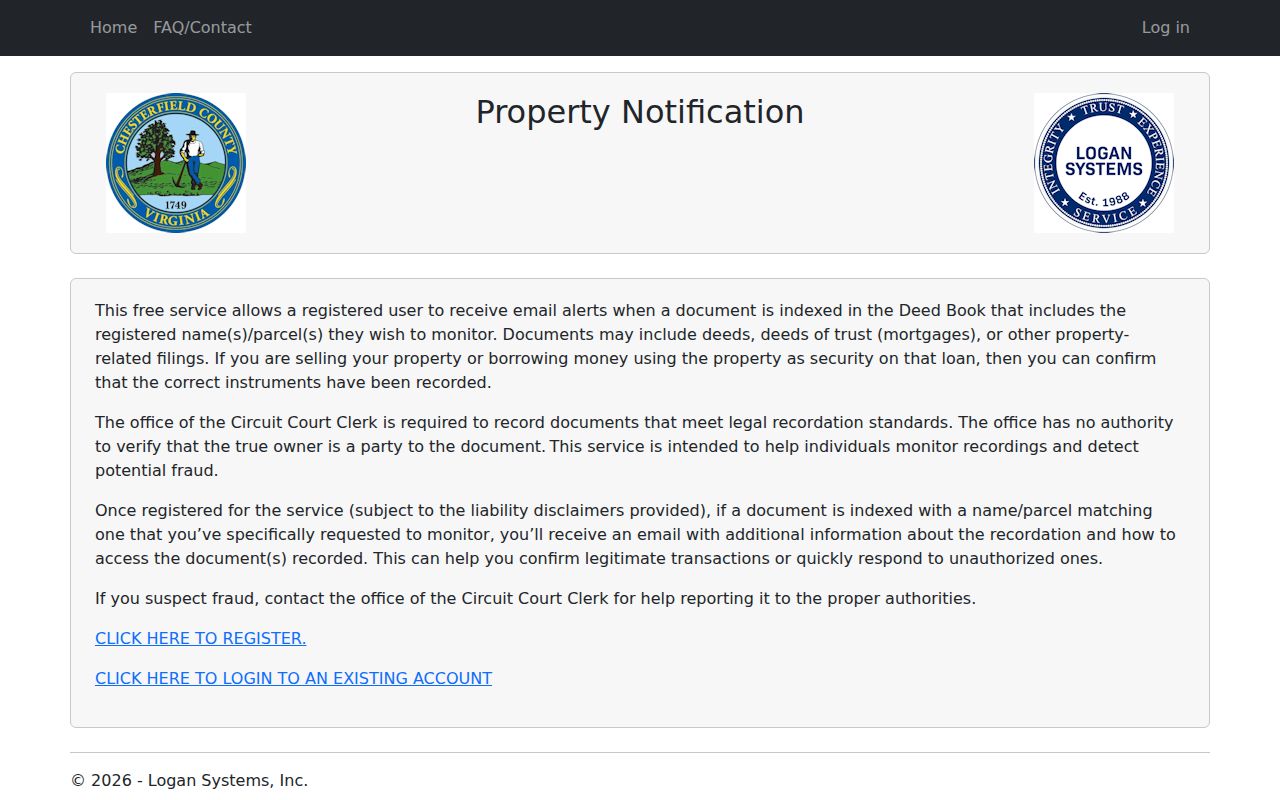
Treat each message as notice to review a filing. The recorded instrument, along with sound legal advice, remains the real tool for assessing a dispute.
Getting a Chesterfield County Deed Copy
The Record Room at the Courts Building, 9500 Courthouse Road, opens its deed records for in-person inspection on weekdays from 8 a.m. to 4 p.m. Land-record recording hours run 8 a.m. to 3:30 p.m. Copies cost $0.50 per page. Certification adds $2 per document. Phone requests paid by card carry a further $2 processing fee plus postage. For a mail request, name the party, the document type, and the date, and include a check or money order payable to Chesterfield Circuit Court.
Call 804-717-6517 for copy help. Land-record staff answer at 804-748-1285. The Clerk does not supply recorded information by phone or email as a substitute for index research. If a document falls outside public online coverage, ask how to locate the older book or microfilm before requesting a copy.
Other land-related filings carry their own recording charges. UCC documents affecting real estate cost $20. Domestic judgments cost $10, and foreign judgments cost $25. A release is listed without a fee. Those charges apply to recording those instruments, separate from per-page copy fees. Confirm the current fee schedule and accepted payment method with the Clerk before mailing a filing or planning a Chesterfield County deed copy request.
Recorded, not guaranteed. The index points to an instrument on file; it does not establish clear title or reveal every unrecorded interest. The Clerk cannot perform a title search or give legal advice.