
Values in a Chesterfield County Property Record
Chesterfield County assesses real estate at 100% of fair market value every year. The number serves the tax roll. A private appraisal answers a sale or lending question. A deed may state consideration on its first page. That amount is a transaction record, though, not a professional opinion of what the property is worth today.
| Value | What It Is | Where |
|---|---|---|
| Assessed value | Annual county value used in the real-estate tax calculation. | READ / Real Estate Assessments. |
| Market value | The county's full fair-market-value assessment; not a private appraisal. | Annual assessor record. |
| Sale consideration | Amount stated on the first page of a deed or instrument when required. | Recorded deed; exact portal field not verified. |
| Land and improvements | Improvement information is described; a separate value split was not verified. | READ result; check the live card. |
The numbers differ for a reason. Chesterfield analyzes sales, inspects property, and compares similar homes to set each annual assessment on the tax roll. A recorded sale reflects one transaction on one day. A private appraiser, by contrast, weighs current conditions and details that a mass assessment does not address.
Chesterfield County Full-Value Assessment
Virginia requires 100% of fair market value. Chesterfield follows that standard county-wide. Its assessment office inspects property, collects and analyzes sales, and compares similar properties within a neighborhood. That method runs annually across the whole county. It does not guarantee that every assessment equals the price a specific buyer would pay on a given day.
The 2026 base county real-estate rate is $0.89 for each $100 of assessed value. The math is simple. A $100,000 assessment produces a base figure of $890 before special district charges or account adjustments. A parcel in a service district can differ. Any relief entry depends on the actual account. Confirm the amount due with the Treasurer's bill rather than treating this arithmetic as an invoice or a forecast of market value.
The Real Estate Assessments page describes the standard and the current roll, and it displays the county's valuation context.
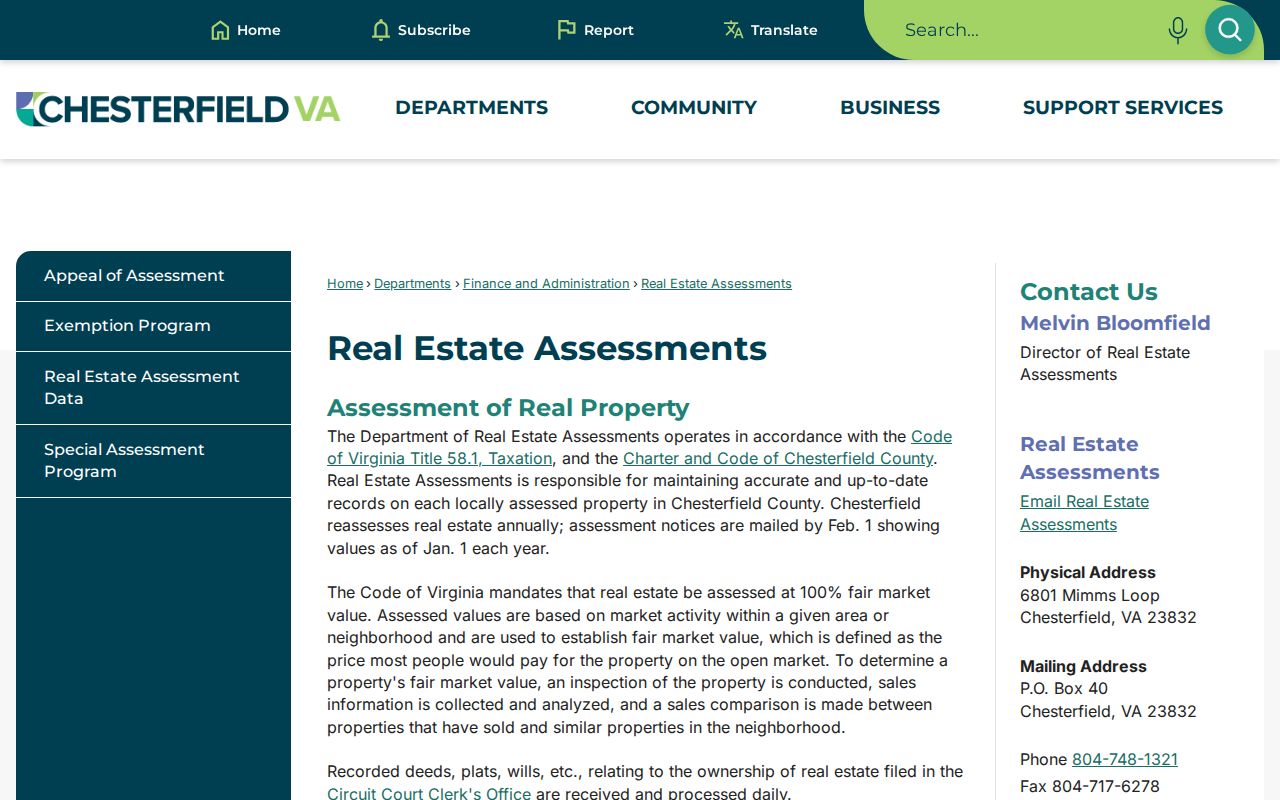
Read the value as the county's tax-cycle assessment. A sale price and a licensed appraisal answer separate questions entirely.
Chesterfield County January Value Date
Chesterfield sets its assessed value on an annual cycle with a January 1 value date. Notices go out by February 1. A deed recorded after that date can describe a newer transaction than the assessment reflects. The roll may still show the prior owner and value.
The assessor processes deeds, plats, and wills daily. The county publishes no fixed closing-to-roll lag. Compare the date on the value notice with the recording date on the deed before treating the two amounts as directly comparable.
Looking Up a Chesterfield County Property Value
Use Real Estate Assessment Data, or READ, for the Chesterfield County assessed value. Search by situs address or the 15-digit tax ID. Then confirm the matching legal description. Owner name appears in a result, but the county's 2025 assessment report does not allow direct owner-name searching online. Check the live card for every field.
- Open READ from the county's assessment page.
- Search by address or full 15-digit tax ID.
- Confirm the result's situs address and legal description.
- Note the assessment year, then compare a separate recorded sale if needed.
- Assessed value
- The county's annual figure used in calculating real-estate tax.
- Market value
- A value estimate for a date and market context; it is not automatically a sale price.
- Sale consideration
- The amount stated in a deed or transfer instrument, not an appraisal.
- Reassessment
- The county's annual review and update of real-estate values.
Chesterfield County Sale Consideration
Chesterfield deeds must state consideration on the first page. That recorded amount helps when reviewing a past sale. It says nothing about what the property would sell for now. A deed can be part of a family or estate transfer. Stated consideration never replaces a market analysis.
The Circuit Court Clerk's index is organized by party name and runs online from 1967 forward. A live search result may or may not display consideration or a sale price. Inspect the instrument itself. Never assume a parcel card carries a transaction field.
Virginia requires the tax ID and consideration information on the first page of a deed affecting real estate, subject to the stated disclosure rules. The 15-digit number links a sale instrument to an assessment parcel. The recorded consideration describes a past filing. Transfer type and date can both affect it. Treat it as a transaction clue rather than a current valuation, and note that the Clerk will not knowingly accept an instrument containing a Social Security number.
Chesterfield County Land and Improvements
The assessment record includes value and improvements. A separate land-versus-building split, sketch, exemption, or value history is not guaranteed to appear in a READ result. Check the current record for those details. Real Estate Assessments can answer field-level questions directly.
The land description and tax ID still matter. A split or improvement record is only useful when it refers to the same parcel and the same assessment year.
Chesterfield County District Charges
Not every charge on a Chesterfield County tax bill tracks market value. Some come from special service districts. Magnolia Green's community development authority funds transportation infrastructure. Its annual special assessments show up in assessment and tax records. Two other districts add supplemental real-estate rates. Chesterfield Towne Center-Southport adds $0.02. Eastern Midlothian Turnpike Corridor adds $0.03.
These entries explain why a total bill can exceed a simple base-rate calculation. The Treasurer holds the account itself. Due dates, balances, and payment history sit on the Chesterfield County property tax records page. That page covers this side of the record.
Chesterfield County Value Changes
Chesterfield County reassesses values every year. A number is tied to a cycle, not fixed to a home forever. Notices and appeal dates are part of that process. A new value can come from sales analysis, a property inspection, or comparable neighborhood properties. An online lookup cannot explain every adjustment on a parcel card.
A dispute over the assessed amount follows the county's current appeal instructions. An appeal works within the tax valuation process. It does not set a sale price or change the deed.
The county's calendar sets March 15 for an online assessment appeal. April 15 is the deadline for a Board of Equalization application. That application follows a timely first appeal. Confirm current deadlines and filing steps with Real Estate Assessments. The appeal page is the official route. The assessor's office can be reached at 804-748-1321. An owner contesting a value should keep the notice and parcel details handy. Questions about a bill's balance or a payment go to the Treasurer. These paths review different records. Neither turns an assessment into a private appraisal.
Limits of Chesterfield County Assessed Value
A Chesterfield County assessed value is simply the county's tax figure for its annual cycle. It is not a buyer's offer, a sale appraisal, a boundary survey, or a title opinion. A recorded sale offers a past transaction reference, but it may be older or reflect circumstances unlike a current sale.
Value vs price. The assessor's figure supports taxation and does not predict what a property will sell for. For a current market opinion, use a licensed appraiser.