
How to Search Chesterfield County Property Records
The address-to-parcel starting point is the county assessment record. Chesterfield's READ system takes a property address or the county's 15-digit tax ID. The result gives you an owner name. It also returns a situs address, legal description, assessed value and improvement information. The Parcel Viewer adds a map view with local layers.
A recorded transfer needs a different index. The Circuit Court Clerk's deed index searches by party name, not street address. So keep the owner names and tax ID close at hand. They carry you from the parcel result to the deed records.
Know what each record can prove. An assessment or deed record shows what an office recorded or valued. It cannot establish clear title, settle a fence line, or predict a sale price. Keep the newest deed, the assessment roll and the map in their own roles.
- Search READ by the property's situs address or exact 15-digit tax ID, then save the owner name and legal description.
- Use the owner as a party-name clue in the Circuit Court Clerk's deed index; check grantor and grantee roles.
- Open the Treasurer's Citizen Portal for the tax account, invoices and payment status.
- Use the Parcel Viewer for location and context, then compare legal descriptions with an official plat or deed.
- For a copy or older volume, use the Clerk's Record Room or a documented archive path.
Chesterfield County Property Records Offices
Chesterfield stores land evidence, tax values, bills and map data in separate offices. The Circuit Court Clerk records deeds and plats. Real Estate Assessments maintains the annual owner and value roll. The Treasurer bills and collects the tax. GIS maps the parcels. An online search can start anywhere, but the office holding the record remains the source for a certified copy or a correction.
Chesterfield Circuit Court Clerk
9500 Courthouse Road
Chesterfield, VA 23832
804-748-1241
Real Estate Assessments
6801 Mimms Loop, P.O. Box 40
Chesterfield, VA 23832
804-748-1321
Chesterfield County Treasurer
9901 Lori Road, P.O. Box 70
Chesterfield, VA 23832
804-748-1201
For other county records, Virginia FOIA requests go to the public body that keeps the file. Each request should describe the records with reasonable specificity. The normal response period is five working days. A seven-workday extension is possible, and a charge may cover the actual cost of access. Recorded land records follow a separate path. Under the FOIA exemption in Va. Code §2.2-3703(A)(7), the Circuit Court Clerk runs its own access process, so deed copies should be requested from the Clerk rather than through a duplicate FOIA filing elsewhere.
Chesterfield County Annual Assessment Roll
Real Estate Assessments reappraises Chesterfield property every year. The valuation date is January 1. The county mails notices by February 1. Virginia requires assessment at 100% of fair market value. The office reviews sales, inspects property, and compares similar homes within a neighborhood to set each figure. A posted value is still an assessment for tax purposes. It is not a private appraisal or a promise of what a sale will bring.
The 2026 county real-estate tax rate is $0.89 per $100 of assessed value. That rate converts the assessment into a base tax calculation. Special districts and other charges may still appear on the actual bill. The roll updates on its own annual cycle. So the assessed value and a newly recorded deed can carry different dates.
READ is the county's public entry point by address or tax ID. Its page describes the assessment fields, but the application itself is JavaScript based. The county publishes no set number of days between recording a deed. It sets no fixed wait for updating the owner on the assessment roll.
Assessment appeals follow their own calendar. An owner may file an online appeal by March 15. After a timely first appeal, the Board of Equalization application is due April 15. Confirm the current year's dates and steps with Real Estate Assessments, since they can change. Remember that an appeal addresses the assessed value only. The Treasurer's bill and payment balance sit in a separate account system.
Chesterfield County Address and Tax ID Search
READ accepts a street address when you do not yet know the parcel key. The county's standard tax ID runs 15 digits. Copy every digit exactly. That number is also required on the first page of a deed or other instrument affecting real property. That makes it a handy bridge from the assessment roll to the Clerk's land records. The county publishes no digit-by-digit map of the ID. Do not read its parts as a block, lot or map-book code.
The county's READ launch page introduces the search interface. Its text view does not expose every live control. Treat the field list as the documented route rather than a claim about hidden buttons.
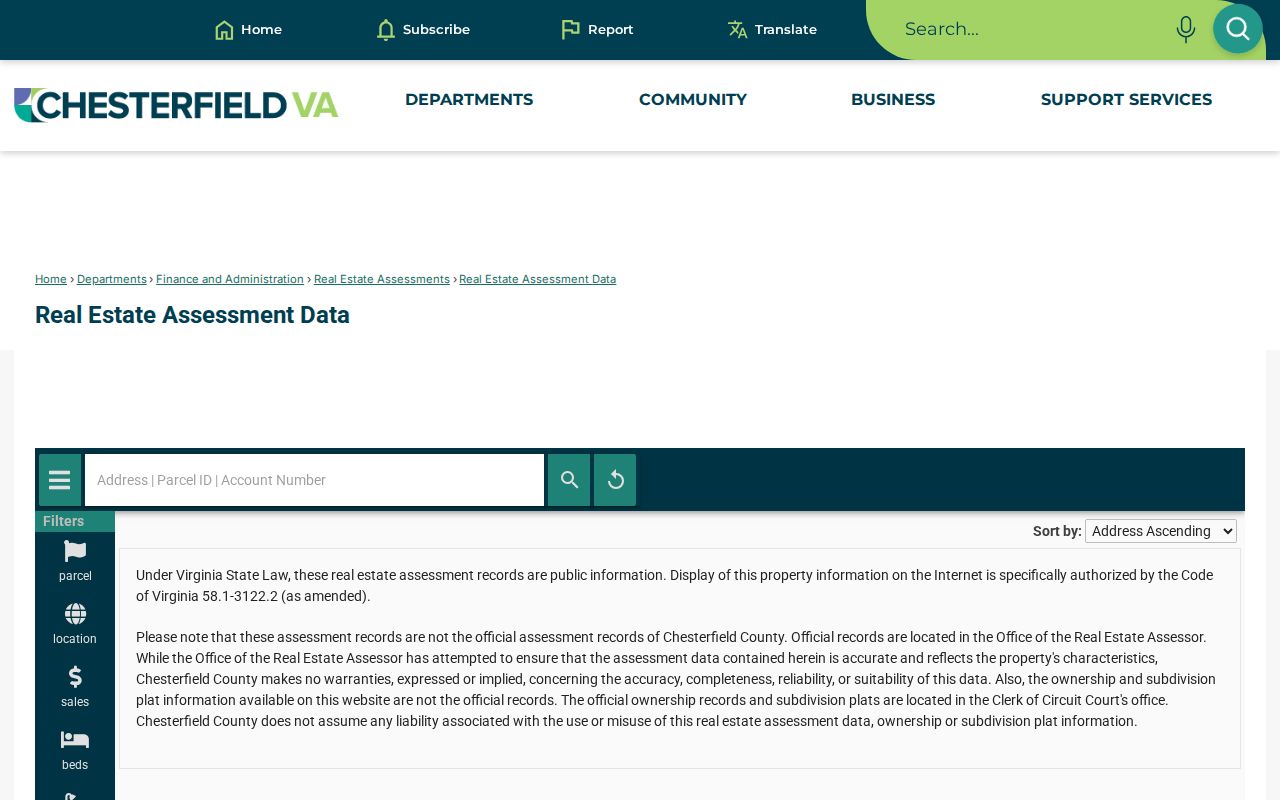
The image shows the assessment search starting point for Chesterfield County. Enter an address there to pull the parcel record.
Use the returned tax ID and legal description to line up the same parcel in the county map and deed systems.
- Tax ID
- The county's 15-digit key for an assessed real-estate parcel.
- Situs address
- The physical address used to locate the property.
- Owner of record
- The name shown on the county assessment roll, which can lag a recent deed.
- Legal description
- The written land description in an instrument or assessment record.
Types of Chesterfield County Property Records
One Chesterfield County parcel can carry several records, each doing a different job. A deed documents a transfer. An assessment record supports the tax roll. The Treasurer's bill shows the charges. A plat or GIS layer places the land on the map. Because the county's offices do not merge these into one ownership file, match the parcel ID and legal description whenever you move between sources.
| Record Type | What It Documents | Kept By | Access |
|---|---|---|---|
| Deeds and deeds of trust | Transfers, loans, releases and other recorded interests | Circuit Court Clerk | Free public index; copies from the Record Room |
| Plats and liens | Recorded lots, easements, liens and judgments | Circuit Court Clerk | Official copies through land records |
| Assessment | Owner name, address, legal description, value and improvements | Real Estate Assessments | READ address or tax-ID search |
| Tax bill and invoices | Charges, payments, delinquency and invoice history | Treasurer | Citizen Portal or office contact |
| Parcel and permit data | Map context, planning cases, inspections and permits | GIS and Building Inspection | Parcel Viewer, GIS hub and ELM |
The Clerk of the Circuit Court holds the recorded transfers. That is where a Chesterfield County deed records search truly begins. The Treasurer's account answers a different question. It shows what is due on the bill right now. Each layer of Chesterfield County property records covers only its own slice. The assessor's appraisal speaks to value, while the GIS map shows location, and neither proves who holds title the way a recorded deed does.
Chesterfield County Deed Index Years
Chesterfield County was formed in 1749, and the Circuit Court Clerk says permanent land records reach back that far. The online deed index runs from 1967 forward. Wills appear online from 1994. Older deeds still exist but usually demand a Record Room visit or archival digging. A long chain of title, or a transfer that predates modern street addresses, is exactly where that split bites.
The index is built on party names. Addresses and legal descriptions are not the organizing key. Take the current owner from READ, search that name as grantee, then pull the grantor from the deed to reach the prior transfer. Repeat that walk backward through the chain. The full legal description and tax ID keep same-name tracts from blending together.
The county's Land Records page lists online coverage and the Record Room process. Treat any portal hit as a lead. The recorded instrument itself is the evidence worth inspecting.
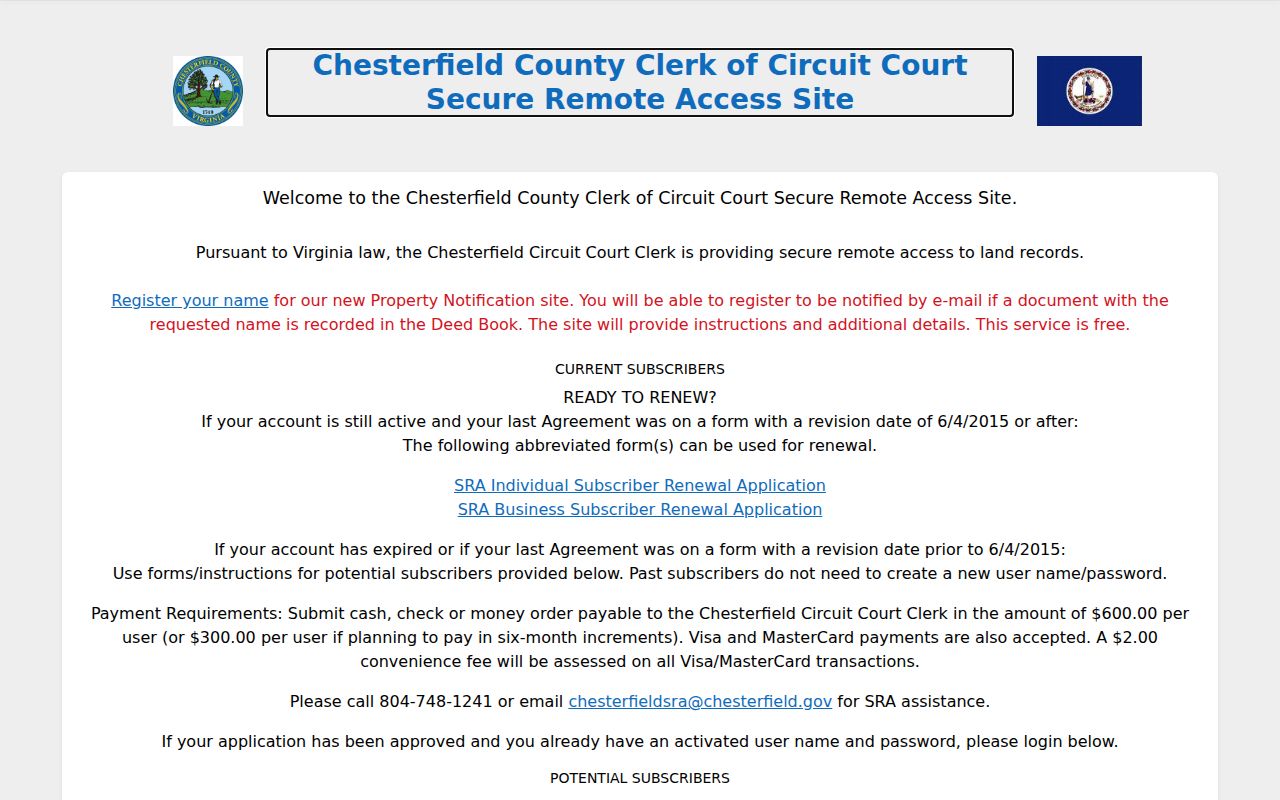
The county's public land-record portal is the online entry point for deed research. Result fields can vary once a search succeeds.
Chesterfield County Parcel Map Layers
The Parcel Viewer is the county's parcel map front door. The hub also offers open data on addresses, streets, parcels and subdivisions. Separate views cover hydrography, political districts, land use plans, planning cases and local historic landmarks. Those layers give a parcel context. They show where a tract sits and how planners treat it. No map layer changes the legal description or produces a survey boundary.
Hydrography places streams, wetlands, resource protection areas and floodplains beside a parcel. Case Information surfaces active and archived planning cases, zoning districts and ordinance overlays. The county calls its Land Use Plan guidance only. It cannot rezone a parcel on its own.
Downloadable data offers a backup route. Use it when the interactive map fights you. The Chesterfield County GIS hub hosts both. The county publishes no download formats or update schedule.
Chesterfield County Tax Bills and Invoices
The Treasurer's Citizen Portal sits apart from READ. It combines accounts for payment and shows invoices for the most recent six years. First-half real-estate tax comes due June 5. The second half follows on December 5. In 2026 that second deadline slides to December 7, since December 5 lands on a Saturday. A bill that never arrives still leaves the charge in place, and the Treasurer can supply a copy by phone.
The Treasurer page links to the portal, and the payment page explains invoice access. Check every bill by parcel and tax year. A district assessment or levy can stack on the base rate.
Magnolia Green's community development authority funds transportation infrastructure, and its annual special assessments appear in assessment and tax records. Service districts at Chesterfield Towne Center-Southport and along Eastern Midlothian Turnpike add small supplemental rates too. That explains most surprises on the bill. Extra lines usually have a reason.
Chesterfield County Permits and Cases
Building permits live outside the deed index. So do plan review and inspection status. Chesterfield runs all of it through Enterprise Land Management, known as ELM. It covers permit applications, inspection requests, plan-review status and comments, inspection status and comments, approved building documents, receipts and Certificates of Occupancy. The public description also mentions permit-data searches. The county publishes no exact search fields or coverage start.
The ELM portal information helps when checking work history or permit status. It is no substitute for a deed or a survey line. Blueprint questions go to Building Inspection or the builder. The Clerk keeps no building plans.
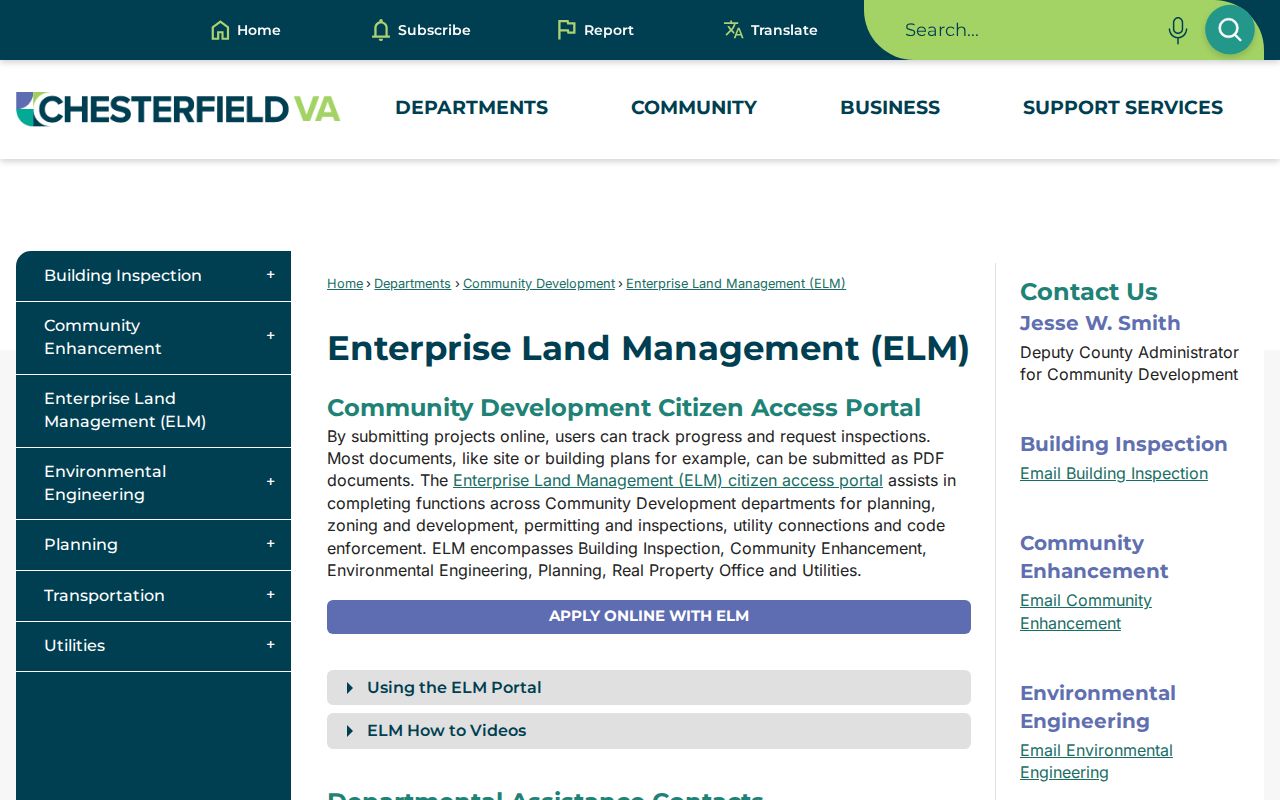
The ELM portal image shows where permit records begin. Treat permit notes as development history, never as proof of ownership.
Chesterfield County Judicial Tax Sales
Unpaid taxes can lead to a judicial sale. Paying someone else's back taxes creates no ownership in Virginia, though. Chesterfield runs the process through the Treasurer and Circuit Court. Under the county's notice, the owner may redeem until sale, the court must approve any sale, and the buyer receives a special-warranty deed without a title-insurability warranty. That last point matters.
Chesterfield keeps no master list of private foreclosures. Track those through the Circuit Court civil docket, a lis pendens filed in land records, and legal notices. County tax cases start elsewhere. Begin with Treasurer delinquency information and the published notices.
The judicial-sale page details notices, redemption and sale limits. Initial notices often trigger redemption, and many listed parcels never sell.
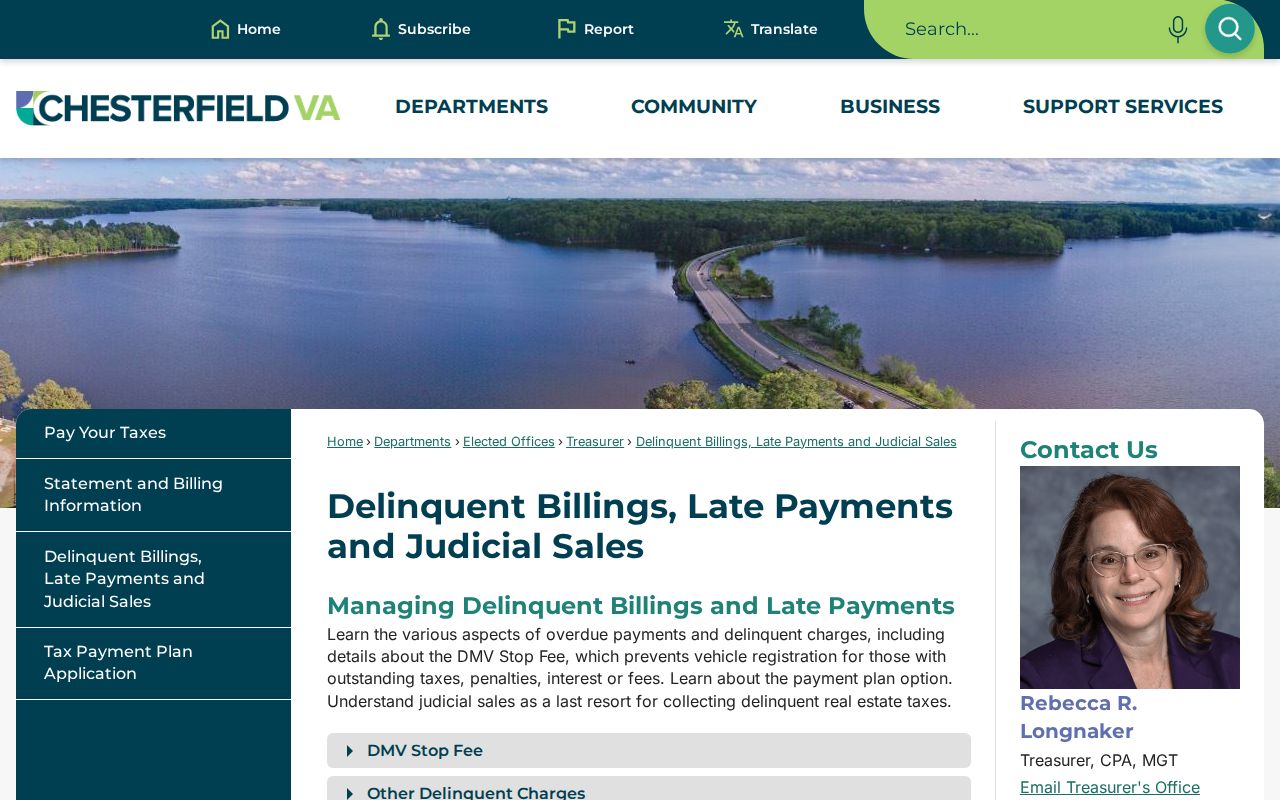
The notice shows a court-run process. Unpaid taxes do not transfer a title in an instant.
Chesterfield County Property Alerts
Chesterfield County owners can sign up for a free alert service from the Clerk. The Virginia Property Notification service sends an email whenever a covered land document is recorded. The recording can be against a registered name or parcel number. That gives the owner of record an early prompt. The owner can pull the instrument and read it. The Clerk's role has a firm boundary. The office records instruments that meet legal standards for recording. It cannot judge whether the person who appears to have signed actually did. So an alert is a starting point. It is not proof that a filing is valid or fraudulent. It is also not a title opinion.
Registration runs through the Virginia Property Notification service. If a notice raises a concern, contact the Record Room. Then review the recorded deed or instrument. Legal or law-enforcement help is the right next step when something looks wrong. The county's 2023 notice spells out both the service and its limits.
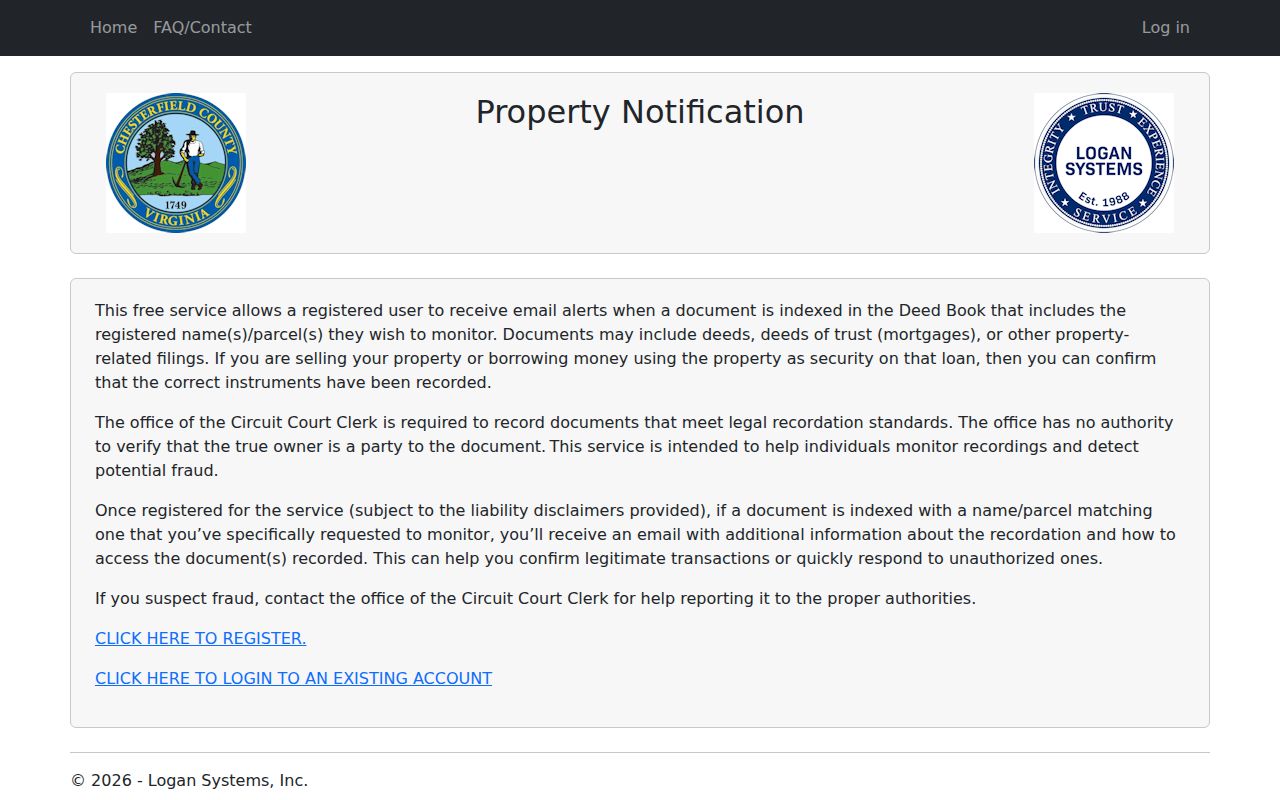
The registration screen is only a monitoring tool. It never substitutes for reading the deed itself or getting a title opinion.
Limits of Chesterfield County Property Records
Chesterfield County property records answer different questions depending on the custodian. The assessor shows who is listed on the tax roll. The Clerk's deed records state what an instrument says. The Treasurer's tax bill tells how the parcel was billed. The GIS map places the land. A permit, lien, plat, or court case may surface too. Each record type carries its own limits on access, timing, and interpretation. A parcel number is worth confirming in more than one system.
Jurisdiction is a common trap when the mailing address names a city. Chesterfield County contains no incorporated cities. Richmond, Colonial Heights, Petersburg, and Hopewell are independent cities. They keep their own deed records and recorders. Midlothian, Chester, Moseley, and North Chesterfield are county locations. Even so, the names sound like towns. ZIP labels can cross a legal boundary without warning. Check the parcel in county GIS first. Then send any request to an office based on the mailing address alone.
Lawful use. Use Chesterfield County property records for property research, due diligence, family history and civic work. Do not use personal information to stalk, threaten or harass anyone; a record search is not a title search or boundary survey.